

5 Premium OEM-Style Exhaust Upgrades That Fit Right
Last Updated: October 30, 2026
Quick Summary
A premium oem style exhaust is a replacement system engineered to match original equipment mounting points, heat shield clearances, and pipe routing, so it installs without cutting, welding, or bracket fabrication. It delivers factory fitment and factory looks with a deeper tone, sitting between stock replacement parts and full aftermarket performance builds.
- Direct-fit OEM-style units bolt to stock mounting points on one specific platform.
- Slip-on mufflers typically install in 0.5 to 1.5 hours with basic hand tools.
- Cat-back systems usually take 2 to 4 hours and may need new gaskets and clamps.
- Stepped-core and chambered baffles disrupt drone; straight-through glasspacks often amplify it.
- OEM mufflers typically last 5 to 10 years under standard driving conditions.
Table of Contents
- What Makes an Exhaust Upgrade OEM-Style
- Cat-Back Systems and Slip-On Mufflers
- Harley-Davidson Slip-On Muffler Performance and Stepped-Core Baffle Benefits
- Headers, Downpipes and Exhaust Tips
- Modular Exhaust System Installation and Fitment Checks
- Ordering Your Forsch Performance Slip-On Upgrade
- Frequently Asked Questions
What Makes an Exhaust Upgrade OEM-Style
The global exhaust system market is projected to grow from $79.38 billion CAD in 2026 to $89.34 billion CAD by 2033, according to Congruence Market Insights' exhaust system market analysis, and much of that demand comes from riders who want more sound without a bike that looks modified.
An OEM-style exhaust is a replacement system engineered to match original equipment mounting points, heat shield clearances, and pipe routing, so it installs without cutting, welding, or bracket fabrication. It sits between stock replacement parts and full aftermarket performance builds. Forsch Performance builds modular slip-on mufflers for Harley-Davidson with stepped-core baffles and a clean OEM appearance.
Below, we break down what separates a true OEM-style system from a universal-fit compromise, how sound and cabin comfort trade off, and what to check before ordering.
Factory Fitment Versus Universal Fit
Fitment is where most disappointments start. A universal-fit muffler clamps to whatever it can reach; a direct-fit, OEM-style unit is built for a specific make and model, with hangers, inlets, and heat shield mounts in factory positions.
- Direct-fit: engineered for one platform, bolts to stock mounting points
- Universal fit: adaptable, but often needs adapters, shims, or custom bracketry
- OEM-style aftermarket: aftermarket internals in a factory-shaped package
Sound and Cabin Comfort Trade-Offs
Loud is easy. Good is hard. A premium OEM-style system should deepen the exhaust tone at idle and under acceleration while staying composed at highway cruise, where drone turns a two-hour ride into a headache. Baffle design does most of that work, which is why stepped-core internals matter more than most buyers realize.
Cat-Back Systems and Slip-On Mufflers
Cat-back systems replace everything from the catalytic converter rearward: mid-pipe, mufflers, and tailpipe sections. They deliver the biggest sound change short of a full header swap, and premium kits maintain OEM-style hanger locations so installation stays straightforward.
Slip-on mufflers are the simpler path: they replace only the muffler canisters and reuse stock head pipes and catalytic converters, keeping emissions hardware intact.
| Component | What It Replaces | Sound Change | Install Effort | Typical Labor Time |
|---|---|---|---|---|
| Slip-on mufflers | Muffler canisters only | Moderate | Low | 0.5-1.5 hours |
| Cat-back system | Mufflers, mid-pipe, tailpipe | Noticeable | Moderate | 2-4 hours |
| Headers and downpipes | Stock manifold and pipes | Largest | High | 4-8 hours |
Sound Profiles: Stock-Like, Moderate, and Aggressive
Sound is why most riders upgrade, but "louder" is not a specification. Judge a premium OEM-style system on idle depth, acceleration character, and highway cruise comfort. Most practitioners group aftermarket exhausts into three profiles:
- Stock-like: within a few decibels of factory at idle and cruise; deeper tone, neighbor-friendly volume. Best for riders who want appearance and a richer note without drawing attention.
- Moderate: a clear step up in idle and acceleration volume with a controlled cruise note. The sweet spot for touring and daily riding, provided the baffle design manages drone.
- Aggressive: noticeably louder at all throttle positions, often sharper and higher-pitched. These frequently produce cabin drone in the 1,800-2,800 rpm highway range, where fatigue sets in on long rides.
Drone is resonance, not just volume: exhaust pulses align with cabin cavity frequencies at steady cruise. Stepped-core and chambered baffles disrupt that alignment; straight-through glasspacks often amplify it. If you ride long distances, prioritize a stepped or chambered core.
Fitment Checks Before You Buy
Fitment is where most disappointments start with any OEM style exhaust, and it is the gap most product listings leave open. Before ordering any cat-back or slip-on, confirm the following against your exact vehicle:
- Make, model, year, engine, and trim: exhaust routing often changes mid-generation. A part that fits a 2017 model may not fit a 2019 with the same badge.
- Catalytic converter configuration: some platforms use a single converter, others use dual converters or a converter plus an OPF. Cat-back systems are designed around one configuration.
- Hanger and clamp locations: OEM-style systems reuse factory hangers; universal systems may require adapters or custom bracketry.
Emissions and Inspection Considerations
Cat-back systems and slip-on mufflers leave the catalytic converter and oxygen sensors in place, but confirm local requirements before installing any exhaust component. Headers and downpipes are where compliance gets complicated: removing or replacing a catalytic converter for road use can conflict with emissions regulations and noise ordinances.
Installation Labor and Total Cost
Labor is the hidden cost listings rarely mention. A slip-on is often a driveway job with basic hand tools, expect 0.5 to 1.5 hours. A cat-back typically takes 2 to 4 hours and may require penetrating oil, a torque wrench, and new gaskets and clamps.
One honest caveat: cat-back kits cost more and ask more of the installer. If your goal is a cleaner look and a richer note without touching emissions components, slip-ons win on value.
Harley-Davidson Slip-On Muffler Performance and Stepped-Core Baffle Benefits
Harley-Davidson slip-on muffler performance depends on flow and backpressure, and baffle design plays a central role in managing both.
Durability matters here too. OEM mufflers typically last 5 to 10 years under standard driving conditions, per Auto Parts' muffler lifespan guidance, so any aftermarket upgrade should meet or beat that bar. Research into sustainable materials for automotive exhaust systems also points to material choice driving both thermal efficiency and long-term performance.
Headers, Downpipes and Exhaust Tips
Headers and exhaust manifolds route burned gases from the engine into the rest of the system. Downpipes connect that manifold to the mid-pipe or turbocharger, and downpipe-back systems pick up from there. These parts shape power output more than any muffler swap, and they are also where emissions compliance gets complicated.
Headers and Manifolds: What Changes and What It Costs
Headers replace the factory cast manifold with tubular primary runners tuned for exhaust scavenging. The mechanism is pulse timing: when the exhaust valve opens, a low-pressure wave travels back up the primary pipe and can help pull the next cylinder's exhaust out during valve overlap.
- Shorty headers: bolt near the factory location, often retain the stock downpipe, and typically deliver modest gains concentrated in the mid-range. Easier to install and more likely to pass visual inspection.
- Long-tube headers: replace the manifold and often the downpipe connection, deliver the largest scavenging effect, and usually require tuning and a shop install. They are also the most likely to raise emissions-compliance questions.
- Factory manifolds: cast iron, durable, and emissions-compliant by design. Replacing them is rarely worth it on a otherwise stock engine.
Measured performance claims deserve qualification. Header gains on a stock engine are modest, often single-digit horsepower at the wheels, and grow with supporting modifications such as intake, cam, and tuning.
Downpipes and Emissions Compliance
Downpipes connect the manifold to the mid-pipe or turbocharger. On turbocharged vehicles, the downpipe is often the single biggest restriction in the exhaust, and replacing it can meaningfully reduce turbo spool time.
The compliance issue is concentrated here. Many aftermarket downpipes are sold as "off-road" or "track-only" because they remove or relocate the catalytic converter. Removing a catalytic converter for road use can conflict with emissions regulations and noise ordinances.
Exhaust Tips: Material, Fitment, and Durability
Exhaust tips and tailpipe accessories finish the look. A well-finished tip in the right diameter and angle completes the OEM aesthetic; a cheap one discolors and pits within a season. The difference is material and coating:
- 304 stainless steel: the standard for premium OEM-style tips; resists corrosion and heat discoloration, and holds a polish.
- 409 stainless steel: common on factory systems; durable but more prone to surface rust than 304.
- Aluminized or mild steel: cheapest, and the first to pit and rust, especially in winter-salt conditions.
Fitment matters as much as material. Confirm the inlet diameter matches your tailpipe, the tip clears the bumper or bodywork at full suspension travel, and the clamp style (bolt-on, weld-on, or slip-on) matches your installation skill.
Watch out: removing emissions components such as a catalytic converter or OPF for road use can conflict with emissions regulations and noise ordinances, per Blessed Performance's regulatory guidance.
Modular Exhaust System Installation and Fitment Checks
Modular exhaust system installation is more forgiving than a one-piece system because you can adjust alignment section by section before final torque. End caps, baffles, and muffler bodies swap without replacing the whole unit.
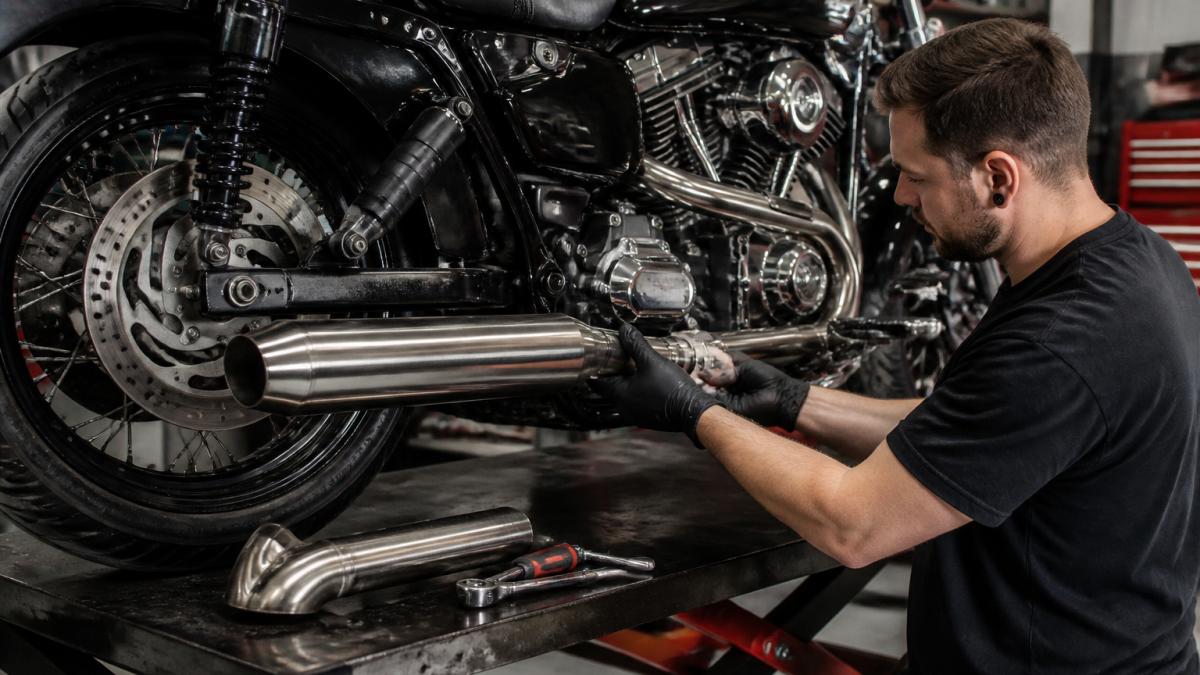
Run this checklist before you tighten anything:
- Confirm the part number matches your exact make, model, and year
- Check heat shield clearance at full suspension travel
- Confirm all fasteners are secure; CSA standards require exhaust systems to be securely fastened to prevent damage to fuel lines, wiring, or other components, per CSA Group standards
Ordering Your Forsch Performance Slip-On Upgrade
Fitment questions are the number one reason riders hesitate. Stepped-core baffles are designed to deliver a sound profile drawn from 70s and 80s racing heritage, with a clean OEM appearance.
Pricing depends on configuration and options, so check our site for current pricing or request a quote. If you ride a customized Street Glide or you are switching from another brand, send us your model and year and we will confirm fitment before you order.
Frequently Asked Questions
What are the benefits of OEM-style exhaust upgrades for Harley-Davidson?
An OEM-style exhaust upgrade keeps the factory look and fitment while changing how the bike sounds and flows. Because it is direct-fit to your make and model, heat shields and mounting points line up without fabrication. That means a deeper tone and a finish that suits the bike's factory look. Fitment and finish matter as much as sound, so check vehicle compatibility before ordering.
Do slip-on mufflers improve performance on V-twin engines?
Slip-on mufflers can improve performance when the internal baffle is designed for exhaust flow rather than noise alone. A stepped-core baffle manages backpressure so the engine breathes more freely while keeping the exhaust tone controlled. Real gains show up as smoother throttle response and stronger mid-range pull. Ask for dyno results specific to your engine and model rather than a generic claim.
How do stepped-core baffles affect exhaust sound and power?
A stepped-core baffle uses graduated internal diameters to shape exhaust flow and sound. The stepped-core design is intended to balance sound level and riding comfort on longer rides. It is a design choice that balances sound level and performance instead of trading one for the other.
Are modular exhaust systems better than fixed systems?
Modular systems let you change baffles, end caps or muffler configurations without replacing the whole exhaust. If you want a stock look now and a different tone later, that flexibility saves money over time. Fixed systems are simpler and often cheaper up front, but every change means a new purchase. For riders who personalize their bike over several seasons, modular exhaust system installation is usually the better long-term value. Confirm the modules are direct-fit for your model before committing.
Your bike deserves an exhaust that fits right the first time and sounds right for years. Forsch Performance builds modular slip-on mufflers with dyno-proven performance, stepped-core baffles, and a factory-clean finish, backed by adaptable configurations and real customer support. Get started with Forsch Performance and upgrade your ride's sound and torque without the installation headaches.

Laissez un commentaire